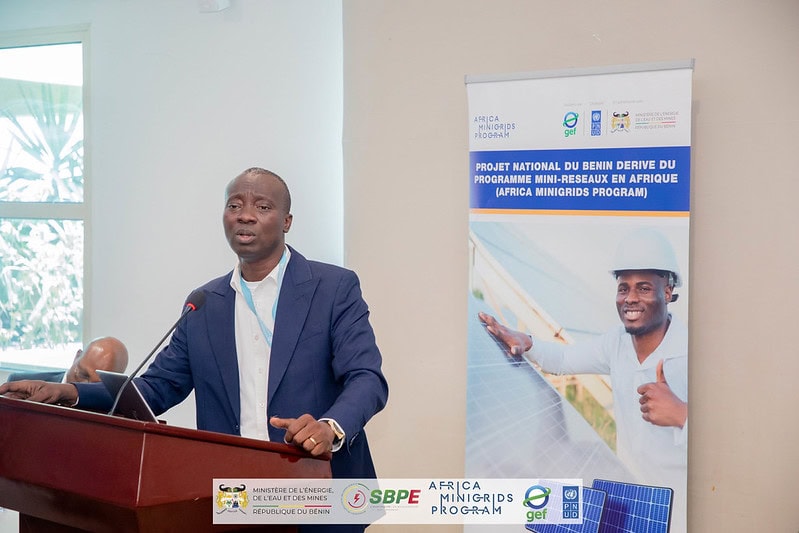
Benin has taken a significant step toward expanding energy access with the launch of a National Dialogue on minigrid development, held on 26–27 February 2026 in Cotonou. Convened by the Ministry of Energy, Water and Mines with support from the United Nations Development Programme (UNDP) under the Africa Minigrids Program (AMP), the two-day event brought together government stakeholders, private sector actors, and technical and financial partners.
The dialogue focused on strengthening viable, inclusive, and sustainable minigrid delivery models, with particular attention to financing structures and private sector engagement. A key milestone was the launch of Benin’s Financial Support Mechanism (MSF), designed to accelerate minigrid deployment in rural and peri-urban communities.
As highlighted during the opening, the success of minigrids depends on both strong service models and effective financing. As AMP National Coordinator Tarcisius Sosthène Toffoun noted, “The success of minigrids is based on the quality of service models and the robustness of financing mechanisms.”
From Strategy to Implementation
The event underscored a broader shift from planning to action, positioning minigrids as a central pillar of Benin’s universal electrification strategy by 2030.
UNDP Resident Representative Titus Oladayo Osundina emphasized the urgency of scaling access: “Without energy, there are no efficient health services, no agricultural processing, and no sustainable job creation.” He further stressed the importance of creating a clear and predictable framework to attract private investment at scale.
Reinforcing this, Émeric Tokoudagba, Director General of SBPE and National Director of the AMP Project, positioned minigrids as a long-term solution: “Minigrids are not a transitional solution. They are a structuring lever for territorial development and an essential pillar of our universal electrification strategy by 2030.”
Supporting Local Impact
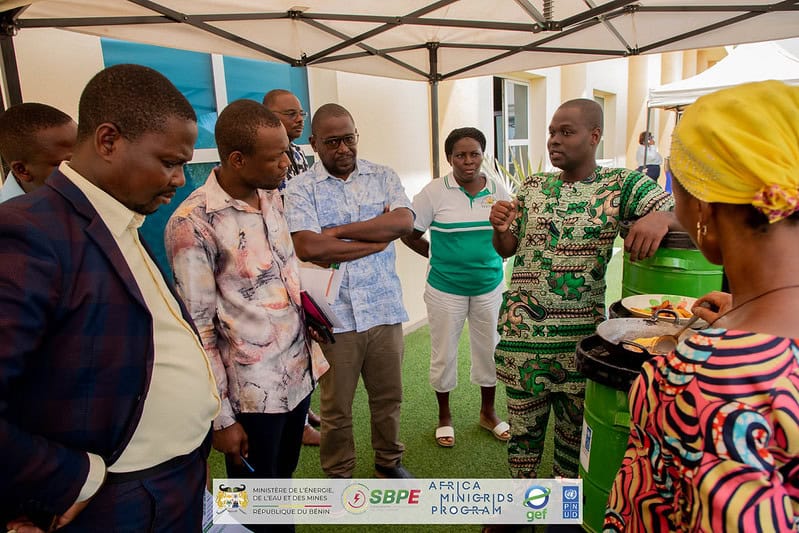
The dialogue also highlighted early results from the Financial Support Mechanism, with the first beneficiaries showcasing how access to electricity is already supporting productive uses and strengthening local economies—particularly for women and young entrepreneurs.
These examples demonstrate how targeted financing, combined with strong policy frameworks, can unlock inclusive growth and accelerate electrification efforts across the country.
The initiative is funded by the Global Environment Facility (GEF). In Benin, the program is implemented by the Beninese Agency for the Electrification and Energy Management (SBPE).