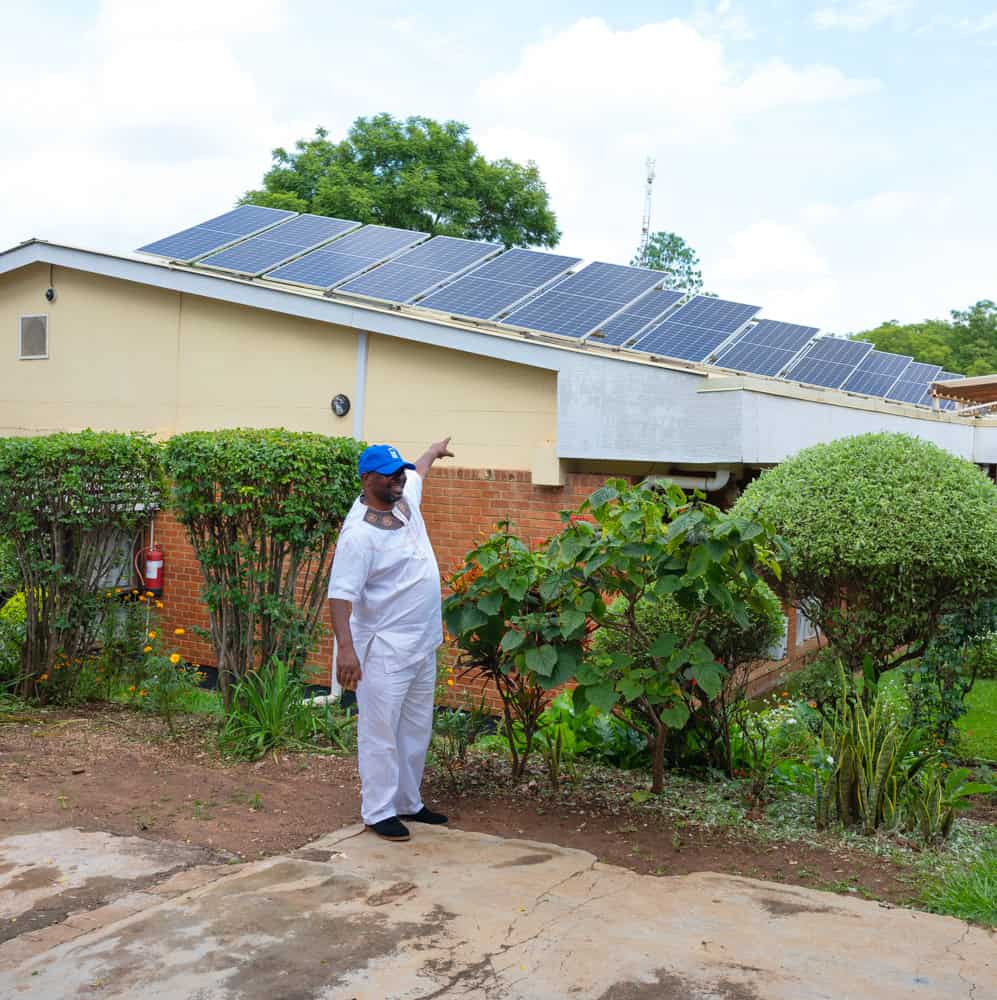
We’re excited to recognize Emmanuel Mjimapemba, Project Manager of the Africa Minigrids Program (AMP) in Malawi, as this month’s Champion!
Each month, AMP spotlights individuals advancing clean energy solutions across Africa at national, regional, and global levels.
Emmanuel is an energy access and development specialist working with the United Nations Development Program (UNDP) in Malawi, where he supports the coordination and implementation of AMP. In this role, he works at the intersection of policy, finance, and energy access, helping to expand access to clean, reliable electricity in underserved communities. Through the development of renewable energy minigrids and a focus on productive use and long-term sustainability, he is contributing to Malawi’s transition toward a more inclusive and resilient energy future.
Q: What’s your story—how did you end up working in the clean energy industry?
A: My journey into clean energy was less of a planned career move and more of a calling shaped by context. Growing up in Malawi, born on Likoma Island in Lake Malawi, we had no electricity or safe drinking water. That was simply a fact of life, but over time I began to see it not just as an inconvenience, but as a fundamental barrier to development.
When I joined UNDP Malawi, I found myself at the intersection of development finance, policy, and energy access. That is where everything clicked. Working on off-grid energy solutions, particularly solar minigrids, I realised that clean energy is not just about kilowatts; it is about dignity, economic opportunity, and resilience. Every community that gains reliable electricity is a community that can run a clinic, keep a shop open after dark, or send a child to school with a charged device.
That realisation has kept me deeply committed to this work. I am proud to say that the islands have since been electrified by the government through minigrids.
Q: Briefly describe your role and involvement with AMP so far.
A: At UNDP Malawi, I have been involved in AMP in a coordination and technical support capacity, working to ensure that program activities translate into meaningful outcomes on the ground. This has included supporting project implementation across minigrid sites, engaging with government counterparts and development partners, and contributing to efforts that strengthen the sustainability of minigrid operations.
A particular area of focus has been exploring innovative approaches to long-term viability, including how surplus energy at minigrid sites can be used productively, as well as ensuring that communities are genuinely engaged and benefit equitably from energy access investments.
Q: What excites you most about the potential of AMP, specifically in your country?
A: What excites me most is the transformative ripple effect that AMP can trigger in Malawi’s rural economy. Malawi has one of the lowest electrification rates in the world, and the national grid alone cannot close that gap at the pace development demands. Minigrids offer a leapfrog opportunity, bringing not just light but also productive use of energy to communities that have waited generations.
What AMP adds is structure, scale, and ambition. I am particularly excited about the potential to integrate productive-use applications such as agro-processing, irrigation, and small enterprises that turn energy access into genuine economic transformation.
In a country where over 80% of the population lives in rural areas, getting this right could be one of the most consequential development interventions of our time.
Q: What is one thing you want people to know about minigrids and access to electricity?
A: Minigrids are not a compromise; they are a solution. There is sometimes a perception that off-grid or minigrid electricity is a lesser, temporary fix until the “real” national grid arrives. But in contexts like Malawi, minigrids are often the most technically sound, cost-effective, and community-appropriate way to deliver reliable electricity.
More importantly, a well-designed minigrid does not just provide power; it anchors a local economy. When a community has stable electricity, health centres can refrigerate vaccines, entrepreneurs can work after dark, and farmers can add value to their produce before it reaches market.
Electricity access is not just an energy story; it is a human development story, and minigrids are writing some of its most compelling chapters.