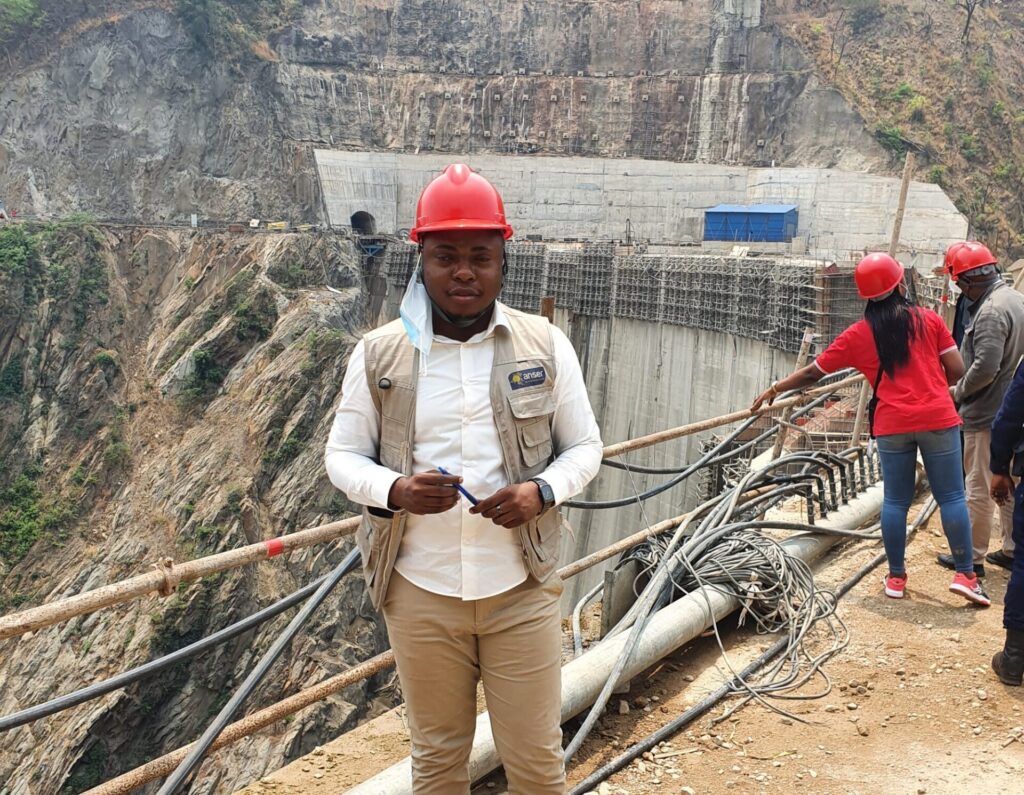
We’re excited to recognize Trésor Seth Tshidibi, AMP Project Manager at ANSER (Agence Nationale de Services Energétiques Ruraux), AMP’s national implementing partner in the Democratic Republic of the Congo (DRC), as this month’s Champion!
Each month, AMP spotlights individuals advancing clean energy solutions across Africa at national, regional, and global levels.
Trésor is advancing renewable energy access in the DRC through his work with AMP and ANSER, the national entity responsible for implementing the program. His role bridges national procedures and international expertise, ensuring that the program’s activities are locally grounded and sustainably impactful. As one of Africa’s largest potential mini-grid markets, the DRC represents a pivotal opportunity, and Trésor’s contributions reflect the critical role of on-the-ground leadership in turning ambition into reality.
Q: What’s your story—how did you end up working in the clean energy industry?
A: My journey into the clean energy industry began with my interest in practical solutions capable of meeting communities’ essential development needs, particularly access to reliable energy. In the Democratic Republic of the Congo, where electricity access remains particularly low in rural and peri-urban areas (less than 1%), I realized that clean energy is a social, economic, and environmental issue.
Established in 2016 by decree, ANSER became operational with the appointment of its executives in mid-2020, marking a significant milestone in the country’s electrification history. I saw this as an opportunity to play my modest part by contributing to solutions tailored to local realities and capable of sustainably improving people’s living conditions.
That is how I came to focus on clean energy, convinced that this sector can solve practical problems while contributing to an inclusive energy transition.
Q: Briefly describe your role and involvement with AMP so far.
A: My involvement with AMP is an extension of my commitment to rural and peri-urban electrification in the Democratic Republic of the Congo. As Project Manager and focal point for ANSER, the national entity responsible for implementing the project, I play a central role in coordinating and monitoring the execution of the program’s various components.
Under the National Implementation Modality (NIM), I ensure that activities are carried out in accordance with national procedures and regulations while incorporating the strategic and technical guidance provided by the regional AMP teams.
My role also involves facilitating collaboration between national stakeholders and international experts mobilized by AMP, in order to ensure effective technical support tailored to the local context. Through this role, I help ensure the program’s consistent implementation and maximize its impact on access to clean, reliable, and sustainable energy for underserved communities.
Q: What excites you most about the potential of AMP, specifically in your country?
A: What excites me most about the potential of AMP in the Democratic Republic of the Congo is its ability to bring about lasting transformation in the electrification market through an approach that goes beyond simply financing infrastructure. The DREI (Distributed Renewable Energy Investment) methodology provides a structured framework for identifying and addressing the key risks that hinder investment in distributed renewable energy projects.
In a country where needs are immense but the perception of risk remains high, the risk-mitigation tools promoted by AMP are a key lever for attracting more private capital and fostering the development of strong public-private partnerships.
This approach not only reduces the cost of capital but also makes projects more bankable and more attractive to investors. In my view, the true potential of AMP for a country that represents one of the largest minigrid markets in Africa lies in its ability to create an environment conducive to large-scale, sustainable investments, using tools that have proven effective in other countries.
Q: What is one thing you want people to know about minigrids and access to electricity?
A: I would like people to understand that minigrids are currently one of the most effective solutions for accelerating access to electricity in rural and remote areas. In countries such as the Democratic Republic of the Congo, where the rural electrification rate remains extremely low, expanding the national grid alone cannot address the urgency and scale of the need.
However, minigrid projects often remain unprofitable in areas with low purchasing power and low consumption density, which justifies the use of public support mechanisms to reduce risks and improve their economic viability.
Furthermore, access to electricity should not be viewed as an end in itself: its impact is greatly amplified when it is accompanied by the development of a value chain geared toward productive uses, such as agriculture, processing, crafts, or small businesses. It is by combining energy infrastructure, tailored support mechanisms, and measures to stimulate productive demand that minigrids can become true drivers of local economic development.