
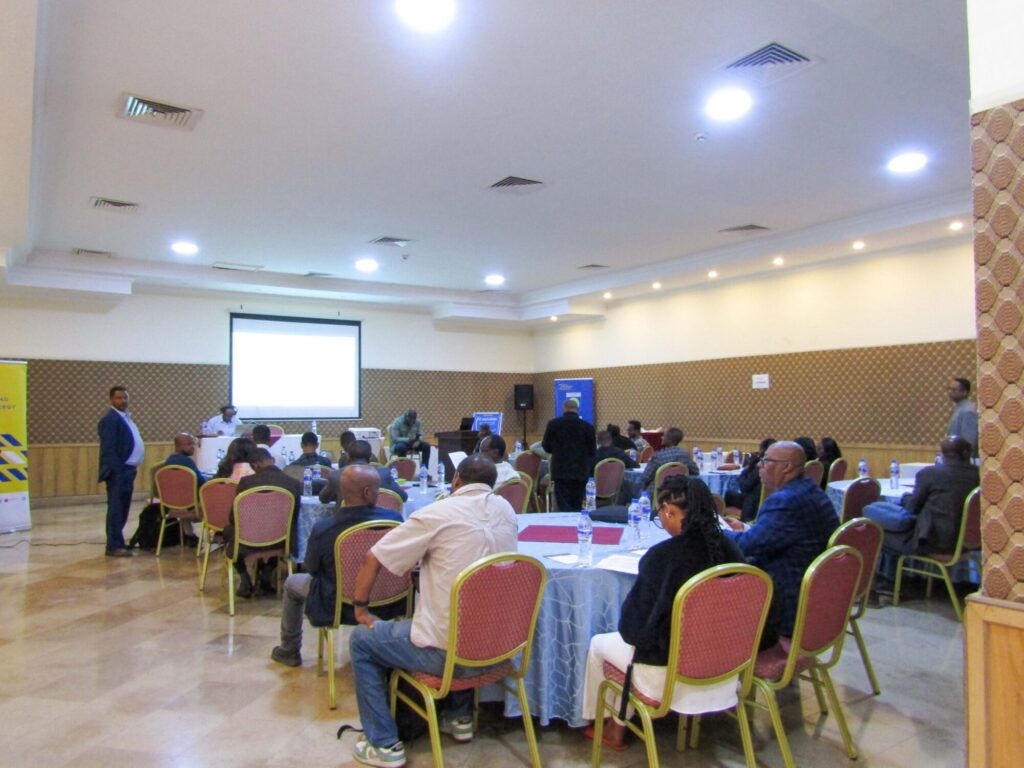
The Africa Minigrids Program (AMP) facilitated a training workshop on minigrid tariff and regulatory tools in Ethiopia, focused on strengthening local capacity to support institutional, technical, and regulatory systems, including tariff design. Participants gained practical exposure to the African Forum for Utility Regulators’ (AFUR) minigrid tariff tool and model regulation toolkit, adapted to the Ethiopian context, tools that can play an important role in reducing investor risk and unlocking private capital to scale and replicate minigrid solutions.
The training brought together a diverse group of stakeholders, including representatives from government institutions, utilities and the energy industry, research and academia, the private sector, development partners, and civil society organizations.
Ethiopia is advancing its role in the Accelerating Sustainable and Clean Energy Access Transformation initiative, part of a broader regional effort to expand energy access across Eastern and Southern Africa. The country is positioning itself as a major renewable energy hub within the Eastern Africa Power Pool, driven by its predominantly renewable electricity mix and growing cross-border power exports. Ethiopia is increasingly recognized as an emerging player in Africa’s energy transition, often described as a renewable powerhouse in the Horn of Africa. This trajectory aligns with global ambitions under the COP28 pledge to triple renewable energy capacity and double energy efficiency improvements by 2030.
At the workshop opening, Wubua Mekonnen, Deputy Resident Representative (OIC) at UNDP Ethiopia, emphasized that decentralized energy solutions strengthen energy security, improve community wellbeing, drive climate resilient growth, and create green jobs for youth, women, and local enterprises while attracting investment. She also highlighted renewable energy minigrids as a practical solution to expand electricity access in rural and remote areas, boost livelihoods, and complement grid expansion in a flexible and scalable way.
The workshop also served as a platform for stakeholder networking, knowledge sharing, and strengthening collaboration across the minigrid value chain, contributing to building a community of practice and enhancing the visibility of ongoing efforts in the sector.
The training was organized by the Ministry of Water and Energy and the United Nations Development Programme, in collaboration with the African Forum of Utility Regulators.
Funded by the Global Environment Facility (GEF) and implemented by UNDP in partnership with the Rocky Mountain Institute and the African Development Bank, the Africa Minigrids Program is a US$50 million country-led technical assistance programme designed to stimulate the solar-battery minigrids market to boost electricity access in 21 countries.
This was originally posted by UNDP Ethiopia.