
Every day, Victoria Ali starts work before sunrise at her rice mill in Namu, a small agrarian town in Nigeria’s Plateau State. But without reliable electricity, milling rice is slow and expensive. Namu has not had stable power for many years, a reality that deeply affects people’s daily lives. Just like Victoria, many others are losing out on income due to unreliable electricity, from market vendors who cannot keep the lights on after dark to fishers who are unable to keep their unsold catch fresh due to lack of refrigeration.
Access to affordable and sustainable energy remains one of the most pressing development challenges of our time. Across sub-Saharan Africa, nearly 600 million people still live without access to electricity, limiting opportunities for growth, productivity and human development.
But the current reality is changing. Across Africa, renewable energy installations are growing at record pace, including in underserved communities.
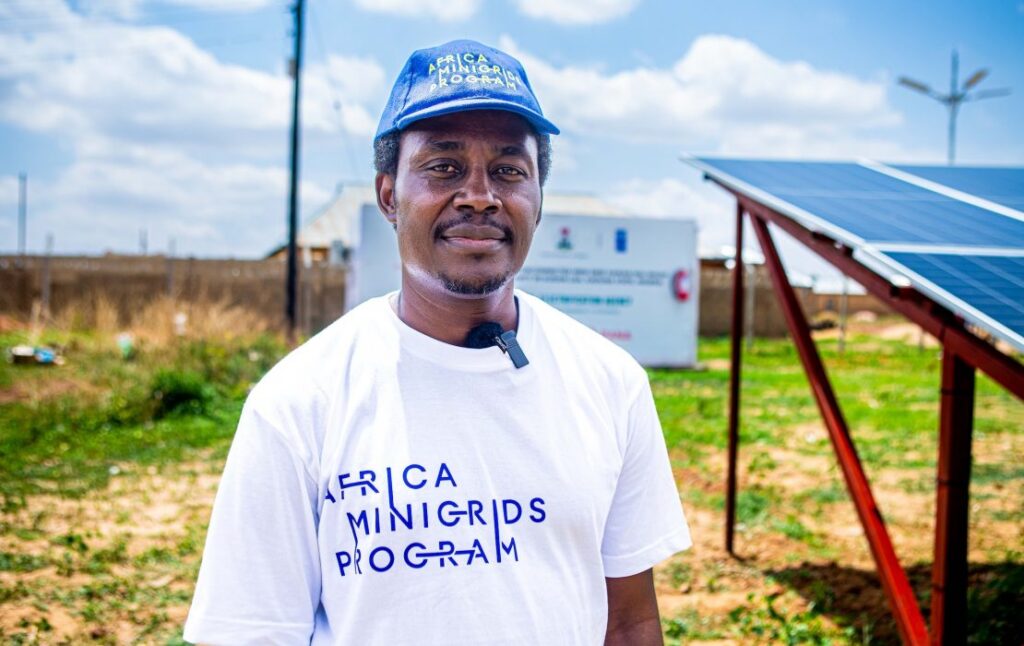
Through the Africa Minigrids Program (AMP), UNDP’s most ambitious sustainable energy access initiative to date, communities across the region are gaining access to reliable, affordable energy through solar-powered minigrids. Each community that gains access to clean energy brings the region one step closer to universal energy access and to realizing a vision of inclusive, sustainable development across Africa.
In Nigeria, with funding from the Global Environment Facility (GEF), and in partnership with UNDP, RMI, the Africa Development Bank and Nigeria’s Rural Electrification Agency, AMP is investing over US$5.9 million in 23 separate sites, including Namu. These investments aim to demonstrate scalable models for solar-powered agribusinesses, climate-smart rural economic development, and gender-responsive enterprise hubs. The initiative aligns with Nigeria’s Electricity Act 2023, Energy Transition Plan, and National Electrification Strategy, and contributes to the country’s climate commitments under the Paris Agreement. It is expected to mitigate approximately 74,000 metric tons of CO2 over the lifetime of the minigrid investments by replacing diesel and fuelwood with solar energy.
In line with these goals, in 2025, AMP brought solar-powered minigrids to more than 14 communities across all six geopolitical zones, transforming daily life for over 20,000 people. Small businesses are now benefiting from new opportunities for income, increased productivity, and safer, more reliable energy access.

A big part of the programme’s success revolves around supporting women to improve their lives and become leaders in the sustainable energy transition. Access to energy can be a game-changer for women in Nigeria. It can lighten the work that women generally undertake to support their families and households, through electric machinery that processes grains, solar powered boreholes that facilitate water access and refrigeration that saves food. It can also enable them to have increased access to education and earn more income.
But electrification initiatives frequently overlook the energy needs of women. Patriarchal norms often place men in positions of authority and shape women’s access to resources and decision-making in the country’s rural communities, according to a gender analysis conducted with support from AMP. Women typically undertake a lot more unpaid domestic and care work, creating time constraints that can limit participation in training, consultations and income-generating activities. Moreover, livelihoods are often gender-segregated, with women concentrated in subsistence production, processing, and petty trade, while men more often dominate capital-intensive and commercial value-chain activities. In this context, electrification initiatives often overlook women’s specific energy needs and face challenges to actively involve them as stakeholders. Consequently, women in Nigeria are disproportionately affected by energy poverty.
AMP is working to change that systematically. In recent years, it established a dedicated Technical Working Group on Gender Equality, convening country teams from across Africa to share case studies, refine gender action plans, and strengthen accountability for inclusion. This resulted in a shift in how minigrid programmes are designed, financed and governed.
Habiba Ali, CEO of Sosai Renewable Energy, is one of the women developers delivering minigrids in Nigeria. Sosai oversees two AMP sites delivering a combined 100 kilowatts and powering 600 households. Habiba believes that women can be the new face of the energy sector. “We have a small chat group supporting women interested to get into the energy sector. People need to hear our voices and see that women are here.”


Scaling minigrids requires more than good intentions, it requires data. Investors need to know which communities are viable, which regulations are in place, and how projects are performing in real time. That infrastructure has historically been missing in early-stage markets across Africa.
AMP is addressing this through a network of national and regional digital platforms, being developed with LocateIT, a Kenyan ICT company selected for its deep expertise in spatial data and energy market analytics. Expected to be fully operational in 2026, these platforms will enable data-driven decision-making, real-time performance monitoring, and financing verification — giving both governments and private investors the confidence to act at scale.
So far, UNDP modeling estimates that minigrids are the lowest-cost electrification pathway for 265 million people in AMP’s 21 countries by 2030, representing a $46 billion market opportunity. Realizing that potential means 110,000 minigrids, over 200,000 schools and clinics electrified, and 900,000 businesses powered. It also means that many more women like Victoria can gain access to a more prosperous and inclusive future, powered by the sun.
This was originally posted on climatepromise.undp.org.