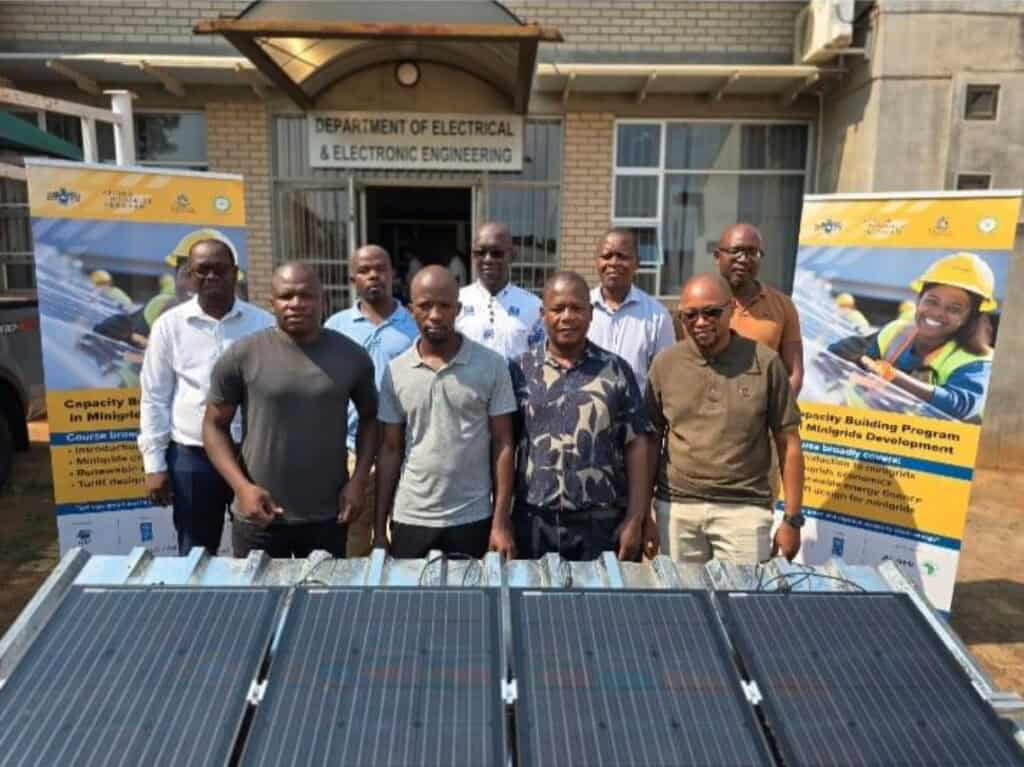
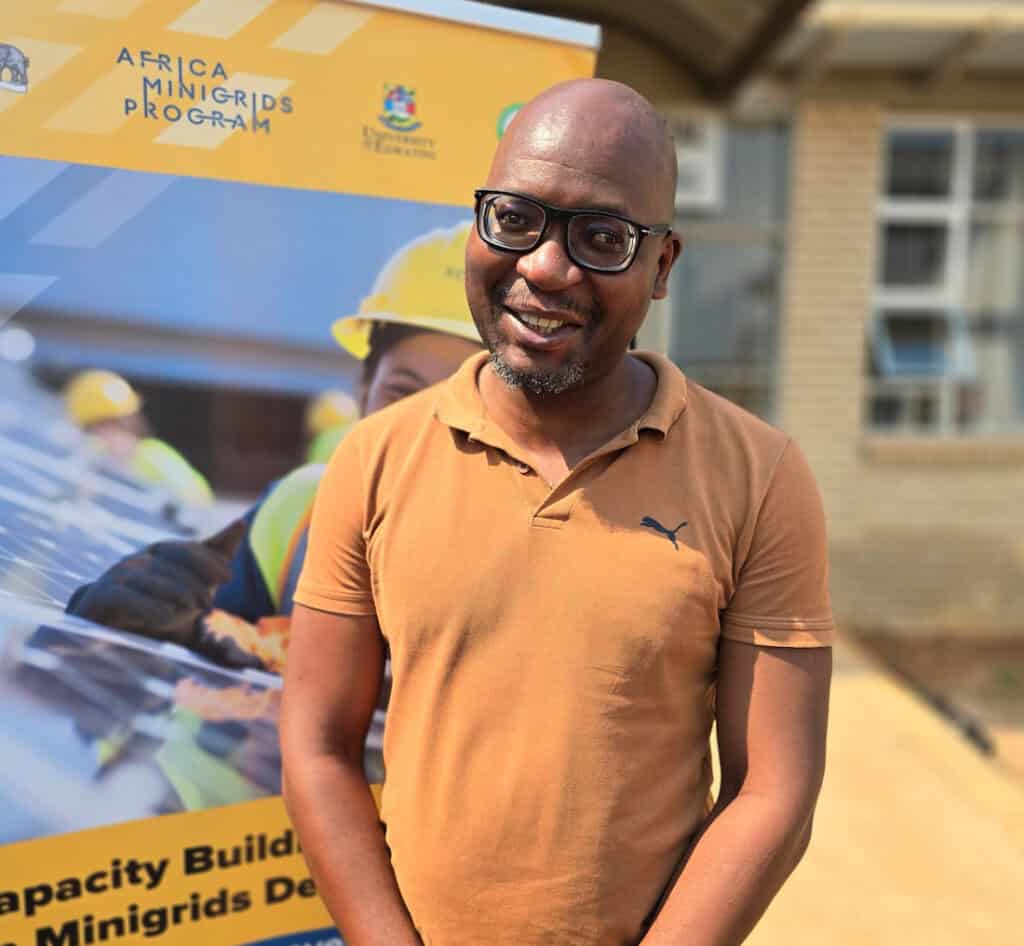
Across Africa, the shift toward decentralised renewable energy is no longer a distant ambition; it is becoming a reality. At the heart of this transition lies a simple but powerful truth: infrastructure alone cannot transform energy systems, people do. This belief drives Cohort 2 of the Minigrids Capacity Building Training Program (MCBTP) under the Africa Minigrids Program (AMP), where instructors are shaping a new generation of renewable energy professionals equipped to design, finance, and sustain resilient minigrid systems in Eswatini and across the SADC region. The program goes far beyond a short technical course and represents a deliberate investment in human capital, blending engineering, economics, finance, policy, and artificial intelligence into a fully integrated learning experience.
Designing a program with global vision and local relevance
For Dr. Gcina Mavimbela, Program Coordinator of the MCBTP, the training was built on academic rigor.
“We followed the fundamentals of designing a university program. Even though it is structured as a short course, we benchmarked it against similar programs globally.”
This ensures that participants are exposed not just to theory but to internationally aligned best practices tailored to Eswatini’s unique energy landscape. The program’s strong regional interest has sparked conversations about expanding its reach, including a potential online version and integration into university qualifications, embedding minigrid expertise into the country’s institutional DNA.
Artificial Intelligence meets minigrid finance
A forward-looking addition to Cohort 2 is the Minigrid Finance module, powered by UNESWA’s Artificial Intelligence Academy. According to Professor Sandile Motsa, integrating AI was both strategic and inevitable.
“AI has rapidly transformed how we structure and shape everyday life. We packaged this course to offer students more than technical knowledge but to also equip them with future-ready skills. Participants are trained to use AI not just as a research tool, but as a co-pilot in the grant financing process, strengthening proposal writing, financial structuring, and analytical depth.”
Professor Simiso Mkhonta adds that AI enhances the technical competence of grant applicants. From modeling tariff structures and cost-recovery mechanisms to understanding demand stimulation strategies, participants learn to develop stronger, data-driven proposals. The course also introduces blended finance and results-based financing frameworks, helping future developers craft projects that are technically sound, bankable, and investment-ready—a transformative skillset in a competitive funding landscape.
Simulating the economics of energy access
Technical feasibility alone does not guarantee project success. The Minigrid Economics module, led by Dr. Differ Mduduzi Mthembu, enables participants to simulate real-world business cases. Guided exercises compare the cost of establishing a minigrid against the cost of extending the national grid to remote sites, examining capital expenditure, operating costs, return on investment, and long-term sustainability. By embedding economic literacy into technical training, the program ensures projects are financially viable, not just technically possible.
From concept to completion: the feasibility imperative
Feasibility studies can determine whether a minigrid thrives or fails. Through the Feasibility Studies for Minigrids module, Dr. Blessed Muchono emphasizes comprehensive project assessment from inception to implementation. Participants use PESTEL frameworks, which examine Political, Environmental, Social, Technological, Economic, and Legal factors, to identify risks, understand community dynamics, and ensure regulatory compliance.This structured approach builds both investor confidence and community trust.
Building more than projects
What sets Cohort 2 apart is its integrated philosophy: engineering is taught alongside economics, finance is strengthened with AI, and feasibility is grounded in regulatory and social realities. This holistic approach prepares participants to move beyond isolated installations toward sustainable energy ecosystems that stimulate local enterprise, expand Productive Use of Energy (PUE), and strengthen rural economies.
With discussions underway for online expansion and deeper institutional integration, the program is positioning itself not as a temporary intervention but as a long-term platform for knowledge transfer. As Africa accelerates its clean energy transition, the instructors’ message is clear: sustainable infrastructure begins with sustainable expertise. Through rigorous training, digital innovation, and strategic foresight, AMP is ensuring that the continent’s renewable energy future is designed, financed, and led by skilled local professionals ready to power inclusive growth for decades to come.
Meet the other Instructors
Dr Blessed MuchonoDr Differ Mduduzi MthembuProfessor Simiso Mkhonta
The program is implemented by the University of Eswatini’s (UNESWA) Centre for Sustainable Energy Research (CSER) on behalf of AMP, led by UNDP with support from the Global Environment Facility (GEF).