
Lessons from AMP’s Madagascar and Nigeria projects on embedding gender into every stage of minigrid delivery.
By Valentina Guido Bergamo, Joëlle Matte
With Contributions from Maxine Chikumbo and Alex Milano
At EAIF 2026, RMI and the Africa Minigrids Program (AMP) brought together women leaders, practitioners, and partners for a dedicated space to connect, exchange lessons, and advance gender inclusion in Africa’s clean energy transition. A clear message emerged from the session: women are entrepreneurs, decision-makers, and innovators whose leadership can strengthen project outcomes and accelerate more equitable energy access. From gender action planning and inclusive procurement to women-led energy kiosks, clean energy fellowships, and targeted support for female-headed households, AMP and its partners are embedding gender across project design, implementation, and institutional priorities.
In support of this work, the AMP regional team launched a Technical Working Group on Gender and Gender Action Plans to facilitate cross-country learning and strengthen gender-responsive implementation across AMP countries.
This article highlights impact and progress reported from a few AMP countries, tips for effective gender action, and where AMP goes from here.
1. AMP Case Studies Highlighted at EAIF: Madagascar and Nigeria
1.1 Madagascar: Gender-Transformative Skills, Jobs, and Women-Led Energy Services
Madagascar’s experience exemplifies how AMP country projects can support women as technical actors, entrepreneurs, and service providers in renewable energy. Building on the Powering Gender Equality initiative, AMP Madagascar supported women’s training in the installation and maintenance of domestic photovoltaic systems, alongside entrepreneurship and leadership. This opened a pathway for women to participate in energy maintenance and service delivery roles that are often perceived as male dominated.
Madagascar’s experience also shows that technical training alone is insufficient. Women’s participation in PV installation and maintenance challenged local perceptions about what constitutes “men’s work” and raised practical concerns related to women’s mobility, care responsibilities, and safety. In response, the project adopted a gender-transformative approach: local authorities were engaged to legitimize women’s participation, community dialogue-built acceptance, and spouses and community members were involved to strengthen support for women’s new roles.

1.2 Nigeria: Gender Mainstreaming Across Project Systems
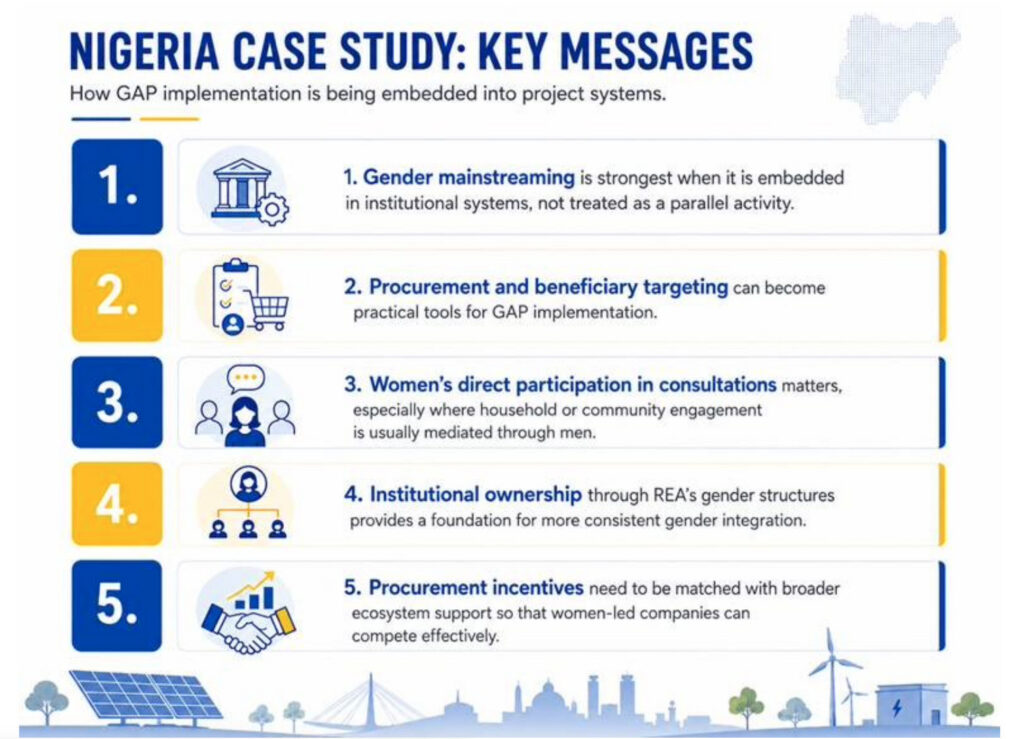
Nigeria illustrates how gender mainstreaming can be built into the systems that shape project delivery. At EAIF, AMP Nigeria and the Rural Electrification Agency (REA) shared how gender considerations are being integrated across the project lifecycle, including design, procurement, market research, development, and operations.
Practical examples include procurement incentives for companies with female leadership or women in the workforce, dedicated forums to gather women’s input during market research, and deliberate efforts to ensure women speak directly in consultations rather than being represented by male household members.
Nigeria’s experience also demonstrates the importance of institutional ownership. The REA is working to integrate Gender Equality and Social Inclusion as a core institutional priority. During AMP’s gender training, the Nigeria team emphasized alignment with Nigeria’s national gender policy, the role of the REA gender unit, and the presence of a gender focal person within the implementing agency. The team also referred to gender-responsive beneficiary targeting, including female-headed households, women-led MSMEs, and marginalized groups.
Additionally, Nigeria’s experience shows that gender-responsive procurement requires continued support for women-led companies. At EAIF, attendees noted that participation by women-led companies in procurement processes remains low, highlighting the need to complement procurement incentives with stronger outreach, capacity building, access to information, financing, and business development support for women-led energy enterprises.
2. GAP Structure and Methodological Notes
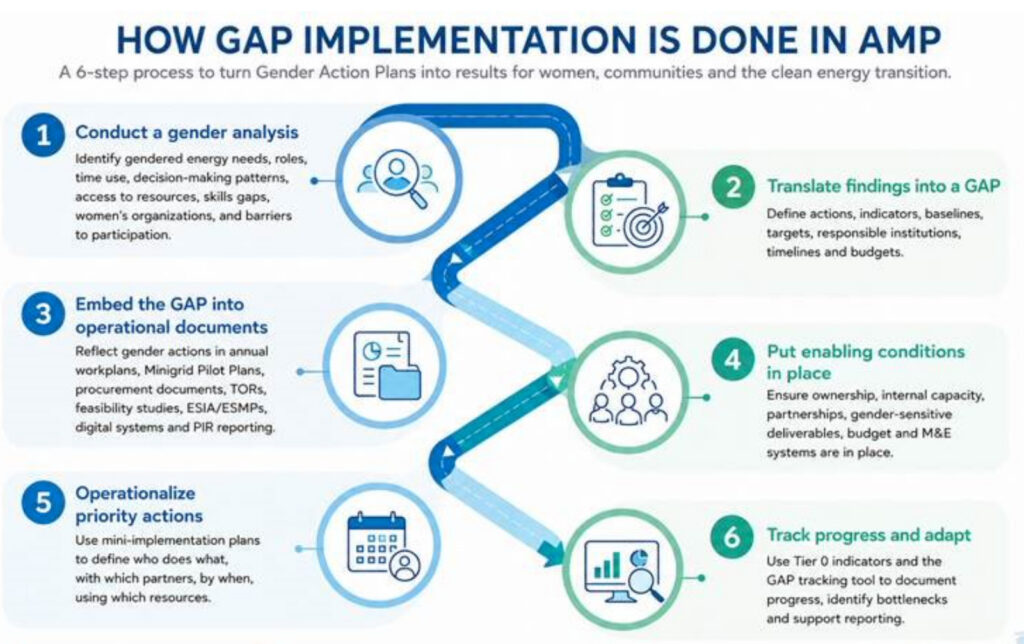
AMP’s experience shows that a Gender Action Plan (GAP) is most useful when it is treated as a project management tool rather than a compliance document. A GAP identifiespriority gender gaps, defines actions to address those gaps, clarifies responsibilities, sets indicators and timelines, and supports monitoring, learning, and accountability. It should be part of core project implementation, not an annex that is revisited only during reporting.
A GAP is not a standalone gender report, a list of general intentions, or an add-on at the end of implementation. It should guide how teams design activities, procure services, consult communities, structure financing, collect data, monitor results, and adapt implementation.
2.1 Six Enabling Conditions for GAP Implementation
AMP’s technical reviews and training materials identify six enabling conditions that determine whether GAPs can move from paper to practice.
| Enabling Condition | Practical Meaning |
| Institutional ownership | The project manager remains accountable, while a Gender Focal Point or gender lead has a clear mandate, authority, and coordination role. |
| Internal gender capacities | PMUs, implementing agencies, and technical partners understand the GAP and can apply gender tools in their work. |
| Partnerships | Ministries responsible for gender, women’s organizations, cooperatives, VSLAs, CSOs, local authorities, financial institutions, and private sector actors support implementation. |
| Gender-sensitive deliverables and documents | TORs, feasibility studies, ESIAs/ESMPs, economic opportunity assessments, MPPs, procurement documents, and digital tools include gender requirements and sex-disaggregated data. |
| Budget and resources | GAP actions are costed, resourced through dedicated budget lines, or mainstreamed into existing project processes and partnerships. |
| Monitoring and evaluation | M&E systems track access, use, benefits, productive use, income, time savings, safety, decision-making, and other gender-related outcomes. |
2.2 Monitoring What Matters
AMP’s training materials emphasize that counting women in electrified households or connected businesses is insufficient. A household connection does not show whether women use electricity, whether appliances meet their needs, whether they control income from productive use, or whether they experience improved safety, reduced time burden, or greater decision-making power.
For this reason, AMP has promoted Tier 0 gender indicators as a common baseline for country projects. These include:
- Number and percentage of women-headed households newly connected to the minigrid
- Number and type of time-saving electric appliances used by women in beneficiary households
- Number and percentage of enterprises, cooperatives, or groups using minigrid electricity for productive use, disaggregated by gender of the owner, manager, or group leader
- Number and type of social facilities connected, such as health centres and schools
2.3 Summary Table: Country Examples and Good Practices
| Theme | Country Examples | Key Message |
| Women’s technical skills and jobs | Madagascar | Training women in PV maintenance and energy services requires local authority support, community dialogue, and attention to social norms. |
| Productive-use financing | Malawi | Women’s access to productive appliances improves when financing is paired with flexible repayment, financial literacy, and delivery through women’s groups or cooperatives. |
| Procurement and beneficiary targeting | Nigeria | Gender can be embedded into project delivery systems through procurement incentives, direct consultation with women, and prioritization of women-led MSMEs and female-headed households. |
| Productive-use governance | Eswatini | Women can take leadership roles in cooperatives and energy hubs, but men and local leaders must be engaged early to prevent backlash. |
| Impact measurement | DRC | Gender-sensitive indicators help capture effects on safety, maternal health, girls’ education, water access, time burden, and household energy costs. |
| Institutional mainstreaming | Nigeria, Ethiopia, Regional AMP | Gender focal points, gender units, TOR requirements, M&E systems, and digital tools help turn GAPs into implementation systems. |
| GAP operationalization | All AMP countries | GAPs need clear actions, responsibilities, timelines, budgets, indicators, and tracking tools to move from commitments to implementation. |
3. Gaps and Challenges
AMP country projects have made important progress in recognizing gender equality as part of minigrid development. However, the technical reviews, TWG sessions, and training discussions show that implementation remains uneven. Several recurring challenges need to be addressed for GAPs to deliver measurable results.
- GAP design and operational clarity
Many GAPs include relevant gender commitments, but some are difficult to implement because actions are too broad, indicators are unclear, targets and baselines are missing, timelines are not specified, or too many institutions are listed as responsible.
- Integration into core project systems
A recurring finding across AMP reviews is that gender actions are often stronger in standalone GAP documents than in the core project architecture. When gender is not reflected in ProDocs, results frameworks, annual workplans, procurement documents, feasibility studies, ESIA/ESMPs, MPPs, digital systems, or PIR templates, GAP implementation remains peripheral.
- Institutional ownership and capacity
GAP implementation often depends on one person, such as a consultant, gender specialist, or Gender Focal Point. While these roles are essential, they are not sufficient. Gender mainstreaming requires shared responsibility across the PMU, implementing agencies, safeguards teams, procurement teams, technical specialists, M&E officers, developers, and partners.
- Budget and resources
Budget remains a common constraint. Several country reviews identify limited dedicated resources for GAP implementation or weak tracking of gender-related expenditures. When gender actions are not costed, they are more likely to be postponed, absorbed into broader activities without follow-up, or implemented only when external support is available.
- Monitoring and measurement
Monitoring remains one of the most important areas for improvement. Many projects report sex-disaggregated participation data, such as the number of women trained or consulted. This is necessary, but it does not capture whether women actually benefit from electrification. AMP projects must track the quality and outcome of participation for a more complete understanding of economic and social gains.
- Social norms and backlash
The Madagascar and Eswatini cases show that gender-responsive interventions can face resistance when they challenge established gender roles. Women’s participation in technical training, energy maintenance, cooperative leadership, or enterprise ownership can raise concerns within households and communities if local norms are not addressed early.

4. Vision and Where We Go from Here
AMP’s next phase of gender work will focus on making GAP implementation more systematic, measurable, and embedded across country projects. The objective is not only to ensure that every country has a GAP, but to ensure that GAPs actively shape how minigrid projects are designed, procured, financed, implemented, and monitored.
- Treat GAPs as living tools
GAPs should evolve as projects move from design to implementation. Where country teams identify new opportunities, generate new results, or find that original actions are unclear, the GAP should be updated. Malawi and Madagascar show why this matters: important gender-responsive or transformative activities emergedduring implementation and were reflected in monitoring and reporting, even if they were not fully captured in the original GAP.
- Embed gender into routine project processes
Gender mainstreaming should be integrated into the processes that already drive project delivery. This includes procurement, feasibility studies, ESIA/ESMP processes, tariff analysis, productive-use strategies, Minigrid Pilot Plans, digital systems, stakeholder engagement, and PIR reporting. This approach improves efficiency because gender analysis and sex-disaggregated data are generated through existing activities rather than added as separate exercises. It also strengthens accountability because consultants, developers, and implementing partners have clear gender requirements in their scopes of work and deliverables.
- Strengthen gender-responsive monitoring
AMP should continue moving from participation counts to indicators that measure access, use, benefits, and empowerment. Tier 0 indicators provide a common baseline, but country teams should also track outcomes such as income generation, job quality, time savings, safety, affordability, mobility, decision-making, and leadership. Stronger monitoring will demonstrate not only how many women are reached, but how minigrid investments affect women’s lives, livelihoods, and opportunities. It will also help country teams identify bottlenecks earlier and adjust implementation before reporting deadlines.
- Resource GAP implementation through budgets and partnerships
Country teams should identify practical resource options for GAP implementation. This includes dedicated budget lines where possible, but also mainstreaming gender into existing workplans, TORs, technical studies, and procurement processes. Partnerships with women’s organizations, cooperatives, VSLAs, local authorities, financial institutions, training centres, and private sector actors can also provide expertise, outreach, facilitation, in-kind support, and co-financing opportunities.
- Continue TWG and peer learning
The TWG demonstrates that country teams benefit from practical exchange on what works, what is difficult, and how other teams are solving similar problems. Future sessions should continue to focus on implementation pathways. This means documenting the steps, partnerships, tools, data systems, risks, and decisions that led to impact. Peer learning can support replication across countries while allowing adaptation to local contexts.
The next phase of AMP’s gender work is about making gender mainstreaming visible in the systems that shape delivery, from procurement and financing to pilots, data, and reporting. GAP implementation is not only about counting women among beneficiaries. It is about ensuring that women can access electricity, use it productively, participate in governance, benefit from jobs and enterprise opportunities, reduce time burdens, improve safety, and exercise greater decision-making power in the clean energy transition.
Learn more: